
Unit 1: Sketchbook Foundations

Unit Overview
The sketchbook is one of the most important tools artists use. Throughout this unit, students will learn how artists use sketchbooks to practice skills, record observations, brainstorm ideas, reflect on their growth, and develop creative habits. Students will personalize their sketchbooks, create organizational systems for daily warm-ups, and complete a decorative name page that showcases their creativity and craftsmanship.
Students will explore the elements of art—particularly line, shape, and pattern—through the creation of Zentangle-inspired designs and decorative layouts. By the end of the unit, students will have a fully prepared sketchbook that will serve as a creative workspace throughout the school year.

Essential Questions
What is the purpose of a sketchbook?
How do artists use sketchbooks to develop ideas and skills?
How can line, shape, and pattern be used to create interesting designs?
How does daily practice improve artistic ability?
How can artwork communicate personal identity?
Learning Targets
Students will be able to:
Explain the purpose and value of maintaining an artist sketchbook.
Demonstrate understanding of line, shape, pattern, positive space, and negative space.
Create a personalized sketchbook cover using Zentangle techniques.
Organize a sketchbook for daily warm-ups and artistic growth.
Apply craftsmanship and creative decision-making to decorative designs.
Develop artistic habits through daily sketchbook practice.
Vocabulary
Sketchbook
Zentangle
Line
Shape
Pattern
Positive Space
Negative Space
Craftsmanship
Composition
Creativity
Visual Vocabulary
Lesson 1: Why Artists Keep Sketchbooks
Important Concept: Sketchbooks
What is the Purpose of a Sketchbook?
Sketchbooks sharpen artistic skills and aid in creative exploration.
A sketchbook is a place to:
Think
Explore
Record
Reflect
Experiment
Practice
Activities that take place in sketchbooks include:
Doodling
Note taking
Collecting references
Writing
Reflecting
Drawing
Collaging
Painting
Brainstorming
All artists, designers, illustrators, architects, and creators keep sketchbooks.
Famous Artist Sketchbooks
Leonardo da Vinci
His sketchbooks were filled with drawings, diagrams, inventions, observations, and written notes.
Other Famous Artists Who Kept Sketchbooks
Paul Cézanne

Frida Kahlo

Christo & Jeanne-Claude

Edward Hopper

Claude Monet

Vincent van Gogh

Tim Burton

Franz Marc

Fun Facts
Pablo Picasso created over 178 sketchbooks during his lifetime.
Leonardo da Vinci filled over 13,000 pages of sketches and notes.
Art colleges often request sketchbooks because they reveal artistic thinking and creative growth.
Your Sketchbook Will Be Used For...
Course Material Practice
Students will develop skills through:
Notes
Worksheets
Technique practice
Artist studies
Experiments
Ideas, Brainstorming, & Sketching
Students will:
Record ideas
Develop compositions
Reflect on artistic growth
Build a personal reference library
Daily Warm-Ups
Students will create mini drawings and written responses that help build creativity and technical skills.
Project 1: Zentangle Sketchbook Cover
Important Concepts
Line
Shape
Pattern
Positive Space
Negative Space
Why Zentangles?
Zentangles are an easy-to-learn, relaxing, and fun way to create beautiful images using structured patterns.
Benefits of Zentangles:
Increase focus
Improve creativity
Encourage mindfulness
Build confidence
Reduce stress
Strengthen drawing skills
One of the unique aspects of Zentangles is that there is no right or wrong result. The final design develops as patterns build upon one another.
Zentangle Guidelines
Create intricate patterns.
Avoid repeating the same pattern more than twice.
Keep patterns relatively small.
Allow patterns to build off one another.
Create a balance of black and white contrast.
Fill the space thoughtfully.
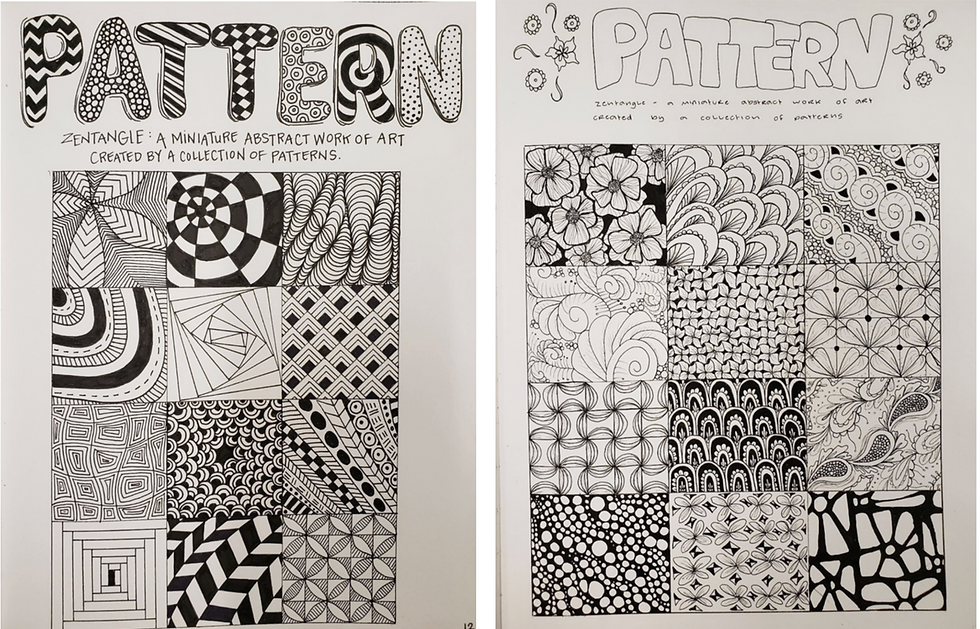
Zentangle Practice Page
Before beginning the cover:
Requirements
You will create two full sketchbook pages on Line, Shape and Pattern.
On the Line and Shape page, you will create the following
12 boxes, labeled with the 12 different types of line and an example
Two boxes for shape including labels and examples of organic and geometric shapes.
On the pattern page, you will create the following:
12 different Zentangle examples
A variety of patterns
Different line qualities
Careful craftsmanship
When finished:
Begin brainstorming symbols that represent you.

Sketchbook Cover Directions
Step 1
Choose a symbol that represents you.
Examples:
Hobbies
Interests
Heritage
Religion
Sports
Music
Favorite activities
Personal values
Step 2
Create several sketches.
Focus on creating an interesting silhouette.
Step 3
Receive teacher approval.
Step 4
Draw your approved symbol large on the front cover.
Step 5
Fill ONLY the negative space with Zentangle patterns.
Step 6
Continue the design onto the back cover.
Step 7
Add your full name to the spine.
Materials
Pencil
Metallic Sharpie (one color)
Success Criteria
✔ Symbol is meaningful
✔ Entire front cover completed
✔ Entire back cover completed
✔ Name on spine
✔ Variety of patterns
✔ Strong craftsmanship
Zentangle Sketchbook Cover Rubric
Criteria | 4 - Advanced | 3 - Proficient | 2 - Developing | 1 - Beginning |
Personal Symbol | Symbol is highly creative, meaningful, and visually engaging. | Symbol is meaningful and clearly developed. | Symbol shows some thought but lacks detail or originality. | Symbol is incomplete or lacks meaning. |
Zentangle Patterns | Wide variety of intricate patterns with excellent visual interest and contrast. | Several patterns used successfully. | Limited variety or repetitive patterns. | Few patterns used or incomplete design. |
Positive & Negative Space | Demonstrates a strong understanding of negative space and uses it effectively. | Mostly correct use of negative space. | Some confusion between positive and negative space. | Limited understanding of the concept. |
Craftsmanship & Completion | Front cover, back cover, and spine are fully completed with exceptional care. | Most areas completed neatly. | Some unfinished areas or careless work. | Project is incomplete or rushed. |
Project 2: Daily Warm-Up Sketchbook Setup
Daily Warm-Ups
Each day students will:
Enter class.
Grab their sketchbook.
Begin the daily warm-up immediately.
Students will have 5–10 minutes to:
Complete a mini sketch
Respond to an essential question
Practice observation and creativity
Why We Do Warm-Ups
Daily warm-ups:
Build drawing skills
Strengthen creativity
Develop visual vocabulary
Encourage artistic risk-taking
Establish productive classroom routines
While students work, attendance and daily logistics can be completed.
Expectations
I have high expectations.
I want your drawings to WOW me.
Work should show:
Effort
Creativity
Thoughtfulness
Growth
Monthly Template Setup
Students will create warm-up pages for the entire year in advance.
Requirements
Each month must include:
Month title
Required number of boxes
Two large Essential Question boxes
Creative decorations
Suggested Themes
Holidays
Seasonal imagery
Anime
Patterns
Personal interests
Color schemes
Monthly Layout Requirements
Page 2
September — 11 Boxes
Page 3
October — 11 Boxes
Page 4
November — 7 Boxes
Page 5
December — 6 Boxes
Page 6
January — 9 Boxes
Page 7
February — 9 Boxes
Page 8
March — 8 Boxes
Page 9
April — 11 Boxes
Page 10
May — 8 Boxes
Remember: Two boxes each month should be larger and reserved for Essential Questions.
Tips & Advice
Some markers bleed through pages.
Place scrap paper behind pages when using markers.
Draw lightly until satisfied.
Use a ruler.
Keep work neat.
Be creative.
Try something different.
Sketchbook Warm-Up Setup Rubric
Criteria | 4 - Advanced | 3 - Proficient | 2 - Developing | 1 - Beginning |
Organization & Accuracy | All months are complete, correctly labeled, and include required boxes. | Most pages are complete with minor mistakes. | Several pages are incomplete or inaccurate. | Many pages are missing or incomplete. |
Creativity & Design | Pages are highly creative, visually engaging, and personalized. | Pages show creativity and effort. | Limited decorative effort. | Minimal creativity shown. |
Craftsmanship | Layout is neat, ruler was used consistently, and pages are exceptionally clean. | Mostly neat with minor errors. | Some messy areas or uneven layouts. | Poor craftsmanship throughout. |
Preparedness | Templates are fully ready for year-long use. | Templates are mostly ready. | Several sections still require setup. | Setup is incomplete. |
Project 3: Sketchbook Page One – Name Design
Project Goal
When someone opens your sketchbook, they should be WOWED by the first page.
Create a decorative name design that demonstrates creativity, craftsmanship, and understanding of line and pattern.
Requirements
Composition
Name must fill most of the page.
Portrait or landscape orientation is acceptable.
Design
Use a minimum of TWO patterns.
Use THREE different line widths.
Use color.
Media
Any dry media:
Colored pencil
Marker
Crayon
Oil pastel
Mixed media
Craftsmanship
No visible pencil lines.
Color applied smoothly.
Clean and intentional appearance.
No rushed work.
Sketchbook Page One Rubric
Criteria | 4 - Advanced | 3 - Proficient | 2 - Developing | 1 - Beginning |
Name Design & Composition | Name fills the page and creates a highly engaging composition. | Name is clearly visible and uses space effectively. | Name is undersized or composition feels unfinished. | Name is difficult to read or incomplete. |
Patterns & Line Variety | Uses multiple patterns and exceeds line variation requirements. | Meets required patterns and line width expectations. | Limited pattern use or insufficient line variation. | Requirements largely missing. |
Use of Color | Color choices enhance the design and are thoughtfully applied. | Color is used effectively throughout the design. | Limited color use or uneven application. | Minimal color or unfinished coloring. |
Craftsmanship | Exceptional neatness and attention to detail. No visible pencil marks. | Mostly neat with minor imperfections. | Several messy or unfinished areas. | Poor craftsmanship or incomplete work. |
Unit Reflection
At the conclusion of this unit, students will have:
A personalized sketchbook cover
A completed warm-up system for the school year
A creative name page
A deeper understanding of how artists use sketchbooks
A strong foundation for future artistic growth and experimentation
Final Sketchbook Inspiration:


Comments